
Island Peak Expedition Nepal is one of the world’s most iconic Himalayan climbing adventures, offering a perfect blend of adventure travel, cultural exploration, Everest Base Camp trekking, and introductory mountaineering in Nepal. The journey begins in Kathmandu, where travelers experience rich Nepalese culture, ancient temples, and UNESCO World Heritage Sites before heading toward the legendary Himalaya.
Trekking through the Khumbu region, the homeland of the Sherpa people, visitors gain insight into authentic Sherpa culture, Tibetan Buddhism, prayer flags, mani walls, and historic monasteries such as Tengboche Monastery. Surrounded by breathtaking Himalayan mountain scenery, the trail leads first to Everest Base Camp and the famous Kala Patthar viewpoint before continuing toward Island Peak (Imja Tse), set among towering Himalayan giants—making this journey an unforgettable Nepal climbing holiday that combines culture, nature, trekking, and high-altitude adventure in the heart of the Himalaya.
ℹ️ Price Information
The displayed price is per person, based on a group of 5–8 travelers. Exact pricing may vary depending on your selected departure date and group size. Please see the Scheduled Departures & Group Discounts section below for available departure dates and the applicable discounted group rates.
Trip Information
-
Kathmandu
-
Kathmandu
-
Spring & Autumn
-
Hotel & Lodge
-
Car, Jeep & Plane
-
6,189 Meters
-
Meals on Trek
-
English, Spanish
-
01-12 People
-
All Trek Permits
-
Fully Guided Tour
-
NHT-231
Trip Overview
The Island Peak Expedition Nepal is a renowned Himalayan expedition that combines the legendary Everest Base Camp Trek with a rewarding first-time mountaineering experience. It is designed for adventurous trekkers ready to progress into high-altitude peak climbing in Nepal. The expedition offers the thrill of a Himalayan summit while following one of the world’s most scenic trekking routes through the Khumbu region, rich in Sherpa culture and Buddhist heritage. With expert climbing guidance, proper acclimatization, and dramatic views of Mount Everest, the journey delivers a perfect balance of Everest trekking, alpine climbing, cultural exploration, and Himalayan scenery in the heart of the Nepal Himalaya.
The journey begins in Kathmandu (1,400 m / 4,593 ft), where travelers explore ancient temples and UNESCO World Heritage Sites before flying to Lukla (2,846 m / 9,350 ft) and trekking into the Khumbu region, homeland of the Sherpa people. Following the iconic Everest trekking route through Namche Bazaar (3,440 m / 11,286 ft), Tengboche (3,860 m / 12,687 ft), Dingboche (4,410 m / 14,469 ft), and Lobuche (4,940m / 16,207 ft), trekkers experience authentic Sherpa culture, Tibetan Buddhism, monasteries, prayer flags, and breathtaking Himalayan landscapes while properly acclimatizing to altitude.
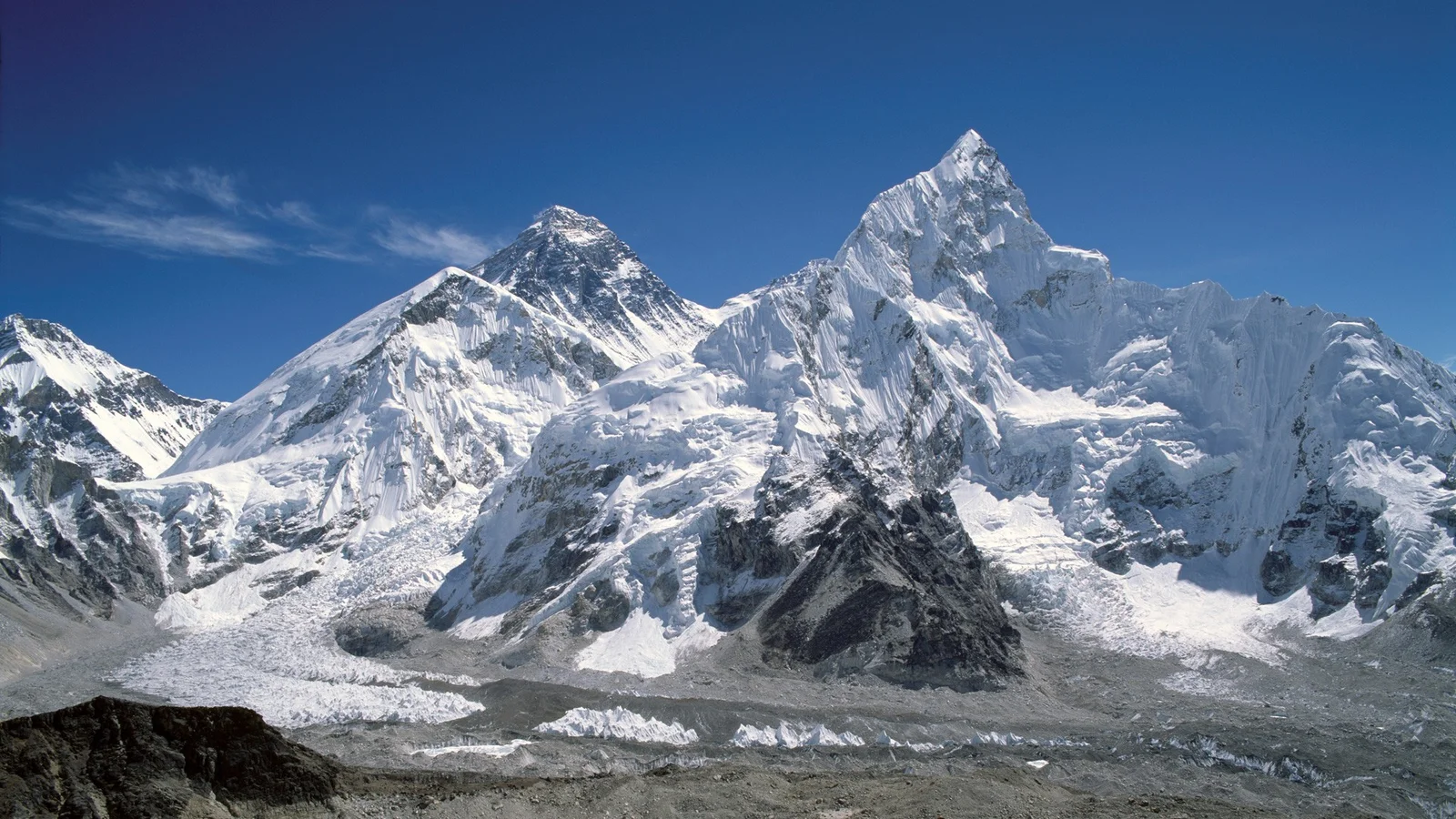
The route reaches Everest Base Camp (5,364 m / 17,598 ft) and the famous Kala Patthar viewpoint (5,550 m / 18,208 ft), offering stunning panoramic views of Mount Everest (8,848.86 m / 29,031.7 ft) and surrounding Himalayan peaks. After completing the Everest section, the expedition turns toward the Imja Valley, where climbers prepare for the ascent of Island Peak (6,189 m / 20,305 ft) with basic mountaineering training, including rope techniques, crampon use, and glacier travel under expert Sherpa climbing guidance.
The Island Peak summit climb is the highlight of the expedition, providing a rewarding technical challenge and unforgettable views from the top of the Himalaya. This adventure is perfect for trekkers seeking their first Himalayan climbing experience, combining Everest Base Camp trekking, peak climbing in Nepal, cultural immersion, and high-altitude adventure, making it one of the best Nepal expeditions for both achievement and experience.
Trip Highlights
- Trek through the remote Khumbu region, traveling across rugged Himalayan terrain that is home to the legendary Sherpa mountaineering community.
- Explore Kathmandu’s UNESCO World Heritage Sites, gaining insight into Nepal’s history, culture, and spiritual foundations before the expedition begins.
- Approach Everest Base Camp via the classic high-altitude route used by Everest expeditions, following historic trails beneath massive Himalayan peaks.
- Ascend Kala Patthar for sunrise, offering commanding panoramic views of Mount Everest, Nuptse, Pumori, and the surrounding Khumbu glaciers.
- Summit Island Peak (6,189m) as part of a fully supported mountaineering expedition led by experienced guides with fixed ropes and safety systems.
- Experience Himalayan spiritual traditions through Tibetan Buddhism, passing ancient monasteries, prayer flags, mani walls, and sacred mountain villages.
- Undertake a demanding Himalayan expedition combining high-altitude trekking, technical climbing, and expedition-style logistics in the Everest region.
Expedition Itinerary
The Island Peak Expedition Nepal itinerary is carefully designed as a day-by-day schedule emphasizing safe acclimatization, gradual altitude gain, and a successful summit attempt. The itinerary allows flexibility to adapt to weather and mountain conditions common in high-altitude environments. To maximize safety and summit success, this recommended itinerary includes sufficient acclimatization days, as shorter itineraries offered by some agencies often reduce acclimatization time and significantly lower the chances of a safe and successful ascent.
Arrive in Kathmandu, the capital of Nepal and widely known as the Temple City, located in the heart of the Himalayas and serving as the starting point of your journey through the greater Himalayan region of South Asia. The city is located at an elevation of approximately 1,400 meters (4,593 feet).
Upon arrival at Tribhuvan International Airport, you will be welcomed in the arrival hall by an airport representative from Jagadamba Holidays, our appointed local partner in Nepal. The representative will be easily identifiable by a clearly displayed welcome sign bearing the name “Natura Himalaya Tours.”
You will then be transferred by private vehicle to your hotel in Thamel, Kathmandu’s main tourist district. The airport transfer covers a distance of approximately 7 kilometers and usually takes around 40 to 45 minutes, depending on traffic conditions. Upon arrival at the hotel, luggage assistance will be provided. Early check-in is subject to availability; if rooms are not immediately ready, your luggage will be securely stored. Overnight accommodation with breakfast will be provided on a twin-sharing basis in a deluxe room at Kathmandu Guest House or a similar standard hotel in Thamel.
The remainder of the day is free for leisure, allowing time to relax or explore Kathmandu’s cultural attractions at your own pace. Thamel offers a variety of cafés, local shops, and traditional streets, providing a gentle introduction to the city’s atmosphere.
In the afternoon or early evening, you will meet our local partner and tour coordinator, Mr Narendra Bohara, at the hotel for a personal orientation session. During this meeting, the trekking plan will be discussed, your local trekking guide will be introduced, necessary travel procedures will be completed, and any remaining arrangements finalised. The remainder of the day is left free, allowing you to rest after your journey and slowly adjust to the rhythm of Nepal’s capital city.
Upon arrival in Lukla, whether flying from Kathmandu or via Ramechhap, there is time to rest, organize trekking gear, and meet your porter before beginning the trek. After a short tea break, the trail descends gently toward Phakding (2,620 m / 8,595 ft), following the Dudh Koshi River and passing through traditional Sherpa villages via Nurning Ghat (2,590 m / 8,497 ft).
The trek covers approximately 8.5 km and takes about 3–4 hours, with a total ascent of around 190 m and a descent of approximately 380 m. This relaxed first trekking day allows for gradual acclimatization while enjoying forested trails, suspension bridges, and scenic Himalayan river valleys.
Phakding (2,620 m / 8,596 ft) is a picturesque riverside village and a popular first overnight stop on the Everest trekking route, offering a gentle introduction to the trek and attractive mountain scenery. There is time to relax and enjoy the surroundings, and overnight accommodation is arranged at Namaste Lodge, a simple, clean, and comfortable mountain lodge with all meals included, providing a pleasant and restful stay. In the evening, the trek is led by a professional local Nepalese guide, who will brief you on the journey ahead and outline the plan for the following day, ensuring a well-organised and enjoyable Everest region trekking experience.
Important Flight Information:
If direct flights from Kathmandu to Lukla are unavailable, travel is routed via Ramechhap (Manthali Airport, 132km & 5 hrs). Guests either depart Kathmandu very early (around 2:00 AM) to catch the same-day Lukla flight or travel in the afternoon (around 3:00 PM) and stay overnight in Manthali.
The direct Kathmandu–Lukla flight takes approximately 35 minutes and usually operates early in the morning, subject to weather conditions and domestic flight schedules. We generally use reliable airlines such as Sita Airlines.
When flying via Ramechhap, the scenic Manthali–Lukla flight takes approximately 20 minutes, offering stunning Himalayan views before landing at Lukla – Tenzing-Hillary Airport.
You can add details and images related to the accommodation.
For Example, Hilton Hotels & Resorts (formerly known as Hilton Hotels) is a global brand of full-service hotels and resorts and the flagship brand of American multinational hospitality company Hilton.


After a hearty breakfast at the lodge in Phakding, the trek begins towards Namche Bazaar (3,440 m / 11,286 ft), following the trail through Monjo (2,835 m). The route follows the Dudh Koshi River, crossing several high suspension bridges adorned with colourful prayer flags. Along the route, the path winds through authentic Sherpa settlements, shaded pine woodlands, and seasonal rhododendron groves, with frequent glimpses of towering Himalayan peaks covered in snow.
The Phakding to Namche Bazaar trek is one of the most popular sections of the Everest Base Camp trekking route. This trek from Phakding to Namche Bazaar covers approximately 9.5 kilometres and usually takes 5–6 hours to complete. The trail gains about 860 metres in elevation with a descent of 190 metres, featuring gradual climbs followed by the famous steep ascent into Namche Bazaar. This section of the Everest trek is considered moderate, making it ideal for acclimatisation and an essential part of any Everest Base Camp trek itinerary.
Namche Bazaar (3,440 m / 11,286 ft) is the largest Sherpa settlement in the Khumbu region and a major trading hub, offering a lively atmosphere with shops, cafés, and bakeries set against a dramatic Himalayan backdrop. Overnight accommodation is arranged at Khumbu Lodge, a simple, clean, and comfortable mountain lodge along the Everest trekking route, providing a welcoming and restful stay. The trek is led by a professional local Nepalese guide, ensuring a safe, well-organised, and enjoyable Everest region trekking experience.
You can add details and images related to the accommodation.
For Example, Hilton Hotels & Resorts (formerly known as Hilton Hotels) is a global brand of full-service hotels and resorts and the flagship brand of American multinational hospitality company Hilton.

An acclimatization day in Namche Bazaar is essential for anyone trekking in the Everest region. Spending an extra day at this altitude allows the body to gradually adapt to thinner air, significantly reducing the risk of altitude sickness later in the journey. Rather than complete rest, a short hike to a higher elevation followed by a return to sleep lower is the most effective acclimatization method and plays a crucial role in the success of any Everest region trek.
The Namche Bazaar acclimatization hike to Khunde covers approximately 8 kilometres and takes around 5–6 hours round trip. The trail ascends about 550 metres and descends the same amount, following well-maintained paths above Namche. This section of the trek offers expansive mountain scenery and a steady uphill walk, making it ideal for acclimatization while remaining physically manageable. The route provides excellent views of the surrounding Himalayan landscape and prepares trekkers for higher elevations ahead.
A major highlight of the hike is a visit to the iconic Everest View Hotel (3,880 m), widely regarded as one of the best viewpoints of Mount Everest and among the world’s highest-located hotels. From its open terrace, trekkers can enjoy spectacular views of Mount Everest, Lhotse, and Ama Dablam. This is an ideal place to pause for refreshments, photography, and rest before continuing on to Khunde, a traditional Sherpa village known for its cultural heritage.
You can add details and images related to the accommodation.
For Example, Hilton Hotels & Resorts (formerly known as Hilton Hotels) is a global brand of full-service hotels and resorts and the flagship brand of American multinational hospitality company Hilton.

After a hearty breakfast at the lodge in Namche Bazaar, the trek begins towards Phortse (3,810 m / 12,500 ft), following a scenic high trail over Mong La (3,975 m / 13,041 ft). The route gradually climbs above the Dudh Koshi valley, passing through alpine landscapes, rhododendron and juniper forests, and open hillsides. As the trail ascends, it offers wide-ranging views of the surrounding Himalayas, creating one of the most scenic walking days in the Everest region.
The Namche Bazaar to Phortse trek via Mong La covers approximately 10.5 kilometres and usually takes 5–6 hours to complete. The day includes an ascent of about 790 metres and a descent of 400 metres. Crossing Mong La provides spectacular panoramic views of Ama Dablam, Thamserku, Kangtega, with distant views of Mount Everest and Lhotse. From Mong La, the trail descends steeply to Phortse Tenga before a steady final ascent to Phortse village. This section of the Everest trek is considered moderate and is well suited for continued acclimatisation.
Phortse (3,810 m / 12,500 ft) is a quiet and traditional Sherpa village in the Khumbu region, set high above the main Everest Base Camp trail and known for its strong mountaineering heritage and peaceful atmosphere. The village offers impressive views of surrounding ridgelines and Himalayan peaks, and overnight accommodation is arranged at Little Sherpa Lodge, a simple, clean, and comfortable mountain lodge providing a restful stop on the trek. The journey is led by a professional local Nepalese guide, ensuring a safe, well-organised, and rewarding Everest region trekking experience.
After a hearty breakfast at the lodge in Phortse, the trek begins towards Dingboche (4,410 m / 14,469 ft), following a scenic trail through the historic Sherpa village of Pangboche (3,985 m / 13,074 ft). The route traverses open hillsides and alpine terrain, offering breathtaking views of the surrounding Himalayan landscape. As the trail progresses, it passes through juniper and rhododendron vegetation and provides sweeping vistas of snow-covered peaks rising above the Imja Valley.
The Phortse to Dingboche trek via Pangboche covers approximately 12 kilometres and usually takes 6–7 hours to complete. The day includes an ascent of about 690 metres and a descent of 190 metres. This section of the Everest region trek offers continuous panoramic views of iconic mountains such as Ama Dablam, Lhotse, and Taboche. The trail becomes more rugged as it approaches the Imja Valley, providing a rewarding high-altitude trekking experience and supporting ongoing acclimatisation.
Dingboche (4,410 m / 14,469 ft) is a well-known trekking village in the upper Khumbu region, often referred to as the “summer valley” due to its wide open pastures and dramatic mountain setting. Surrounded by stone-walled fields and dominated by the impressive south face of Ama Dablam, Dingboche is a key acclimatisation stop on the Everest Base Camp trekking route. Overnight accommodation is arranged at Hotel Tashi Delek, a simple, clean, and comfortable mountain lodge. The trek is led by a professional local Nepalese guide, ensuring a safe, well-organised, and memorable Everest region trekking experience.
An acclimatization day in Dingboche is essential for safe trekking at higher elevations in the Everest region. Spending an extra day here allows your body to adapt to the increasing altitude and significantly reduces the risk of altitude-related issues. Rather than complete rest, a controlled hike to a higher point followed by a return to Dingboche is the most effective acclimatization strategy and prepares you well for the days ahead.
The Dingboche to Nangkar Tshang acclimatization hike covers approximately 5 kilometres round trip and usually takes 4–5 hours to complete. The trail ascends steadily to an elevation of about 5,040 metres (16,535 ft), gaining and losing approximately 650 metres. As you climb above Dingboche, the route passes through alpine meadows and rocky terrain, offering increasingly impressive views of the surrounding Himalayas. From the viewpoint, trekkers are rewarded with outstanding panoramas of Ama Dablam, Lhotse, and nearby peaks, making it one of the best acclimatization hikes in the upper Khumbu.
After returning to Dingboche, the remainder of the day is spent resting, hydrating, and enjoying the peaceful mountain environment. You may take short walks through the village, visit local tea houses, or simply relax at the lodge while taking in the dramatic scenery. In the evening, enjoy a warm meal and time with your trekking group, reflecting on the journey so far. This acclimatization day not only strengthens your physical readiness for higher altitudes but also enhances your overall Everest region trekking experience.
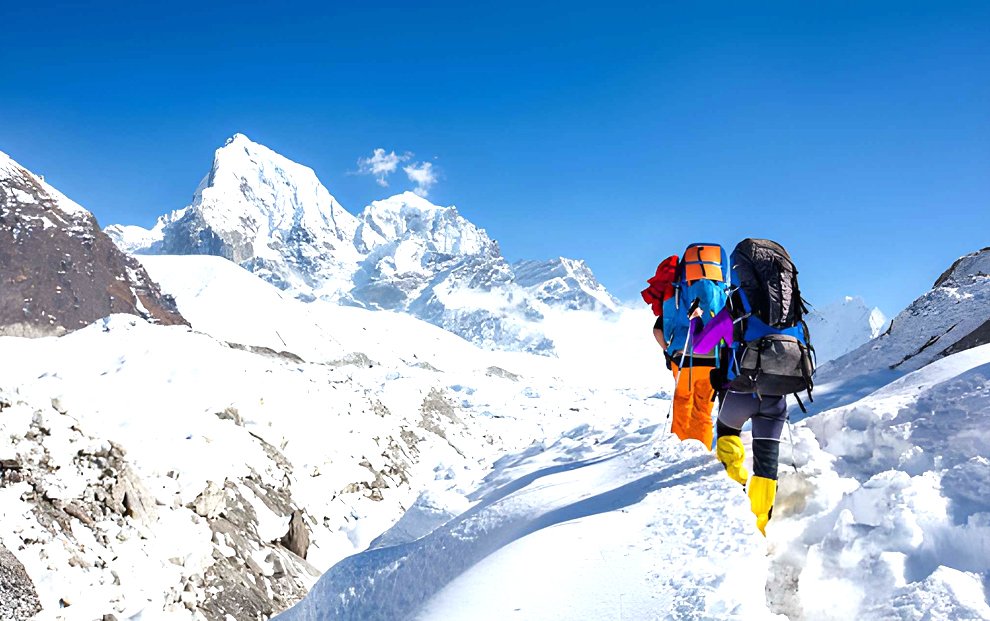
After a hearty breakfast at the lodge in Dingboche, the trek begins towards Lobuche (4,940 m / 16,207 ft), following a scenic high-altitude trail through Thukla Pass (4,830 m). The route gradually ascends through open alpine terrain and rugged glacial landscapes, offering dramatic views of surrounding peaks as the environment becomes increasingly stark and awe-inspiring.
The Dingboche to Lobuche trek via Thukla Pass covers approximately 8 kilometres and usually takes 4–5 hours to complete. The day includes an ascent of about 600 metres with minimal descent. One of the most moving sections of the Everest Base Camp trek is the climb to Thukla Pass, where memorials honour climbers who lost their lives on Mount Everest and neighbouring peaks. Beyond the pass, the trail continues across rocky moraine terrain with striking views of Pumori and Nuptse, making this a challenging yet deeply rewarding trekking day.
Lobuche is a small high-altitude settlement set beneath towering Himalayan giants and serves as an important overnight stop before reaching Everest Base Camp. Upon arrival, overnight accommodation is arranged at New EBC Guest House, offering simple, clean, and comfortable mountain lodging. The remainder of the day is spent resting, hydrating, and preparing for the final approach to Everest Base Camp. The trek is led by a professional local Nepalese guide, ensuring a safe, well-organised, and memorable Everest region trekking experience.
After a hearty breakfast at the lodge in Lobuche, the trek begins towards Gorak Shep (5,140 m / 16,864 ft), following a high-altitude trail across rocky moraines and glacial terrain. After checking into the lodge and taking a short rest, an exploratory hike continues to Everest Base Camp (5,364 m / 17,598 ft), the most iconic destination of the Everest region. This day marks a major highlight of the trek, combining physical challenge with unmatched Himalayan scenery.
The Lobuche to Everest Base Camp trek via Gorak Shep covers approximately 14 kilometres in total and usually takes 7–8 hours to complete. The route includes an ascent of about 424 metres and a descent of 224 metres. As the trail follows the edge of the Khumbu Glacier, trekkers are surrounded by dramatic ice formations and towering peaks. The terrain is rugged and demanding, but the sense of achievement grows with every step as you approach Everest Base Camp, a place that has inspired climbers and adventurers from around the world.
Gorak Shep (5,140 m / 16,864 ft) is the final settlement on the Everest Base Camp trekking route and serves as the overnight stop after visiting Base Camp. After returning from Everest Base Camp, overnight accommodation is arranged at Buddha Lodge, a simple, clean, and comfortable mountain lodge suited for high-altitude trekking. The remainder of the evening is spent resting, hydrating, and enjoying a warm meal, while the trek continues under the guidance of a professional local Nepalese guide, ensuring a safe, well-organised, and memorable Everest region trekking experience.
Experience the unforgettable magic of the Himalayas with an early morning ascent to Kala Patthar (5,550 m / 18,209 ft), widely regarded as one of the finest viewpoints in the Everest region. Beginning before dawn, the climb unfolds beneath a canopy of stars, reaching the summit just as the first sunlight illuminates the surrounding Himalayan peaks in brilliant shades of gold and pink. From Kala Patthar, enjoy breathtaking panoramic views of the Everest massif, including the iconic Mount Everest (8,848.86 m / 29,031.7 ft), making this sunrise ascent one of the most memorable highlights of the journey.
After enjoying the sunrise and spending time at the summit, descend carefully back to Gorak Shep (5,140 m / 16,864 ft) for a well-earned breakfast. Following breakfast, the trek continues toward Dingboche, allowing the body to gradually adjust as altitude decreases. The route follows the classic Everest trail through Lobuche (4,940 m / 16,207 ft) and crosses the historic Thukla Pass (4,830 m / 15,846 ft), traversing rugged glacial moraines and wide alpine valleys characteristic of the upper Khumbu region.
The Kala Patthar sunrise hike and subsequent trek to Dingboche cover approximately 16 kilometres and typically take 8–9 hours to complete. The day involves a total ascent of around 450 metres and a descent of approximately 1,270 metres, making it a long but rewarding trekking day. The route offers outstanding high-altitude scenery and represents a significant and scenic transition point following the Everest Base Camp section of the trek.
Dingboche (4,410 m / 14,469 ft) is a well-known resting and acclimatisation village in the upper Khumbu region, set within a broad alpine valley surrounded by dramatic Himalayan scenery. Overnight accommodation is arranged at Hotel Tashi Delek, a simple, clean, and comfortable mountain lodge suitable for high-altitude trekking. The trek continues under the guidance of a professional local Nepalese guide, ensuring a safe, well-organised, and rewarding Everest region trekking experience.
After a hearty breakfast at the lodge in Dingboche, the trek begins toward Island Peak Base Camp (5,100 m / 16,732 ft) via the scenic village of Chukhung (4,750 m / 15,584 ft). The trail gradually ascends through open alpine valleys and rugged terrain, offering impressive views of surrounding Himalayan peaks as the journey transitions toward the mountaineering section of the expedition.
The route from Dingboche to Chukhung provides striking views of Lhotse, Ama Dablam, and surrounding peaks, with a steady climb across high-altitude terrain. After a short rest in Chukhung, the trail continues toward Island Peak Base Camp, crossing glacial moraines and increasingly rocky ground. The remote landscape and dramatic scenery mark the approach to the expedition base camp.
The trek from Dingboche to Island Peak Base Camp covers approximately 11 kilometres and typically takes 8–9 hours to complete. The day involves a total ascent of around 800 metres and a minimal descent of approximately 20 metres, making it a demanding but rewarding high-altitude trekking day and an important stage for acclimatisation.
Island Peak Base Camp (5,100 m / 16,732 ft) is located beneath the imposing south face of Island Peak, set among glacial moraines and surrounded by towering Himalayan peaks. Overnight accommodation is arranged in well-equipped tented camps, where unlimited drinks and freshly prepared meals are provided by dedicated kitchen staff at the base camp, according to your choice. The expedition continues under the guidance of a professional local Nepalese guide, ensuring a safe, well-organised, and successful Himalayan climbing experience.
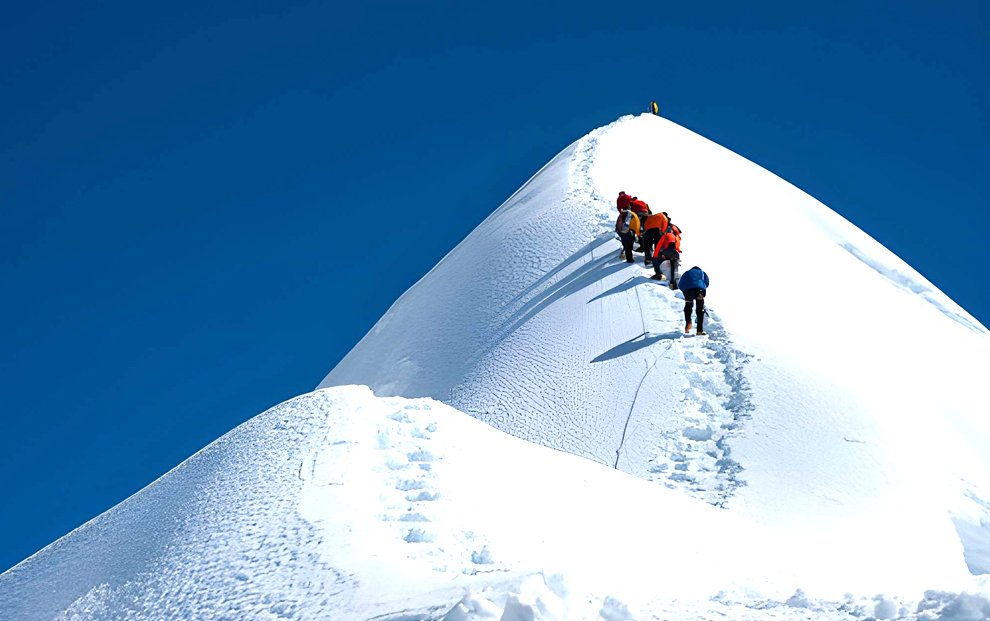
After an early alpine start from Island Peak Base Camp, the expedition sets out for the summit of Island Peak (6,190 m / 20,305 ft), the primary objective of the journey. The climb begins in the early morning hours under headlamp light, following a demanding route across snow, ice, and rocky terrain. With careful pacing and guidance from the climbing team, the ascent progresses steadily toward the upper sections of the mountain.
The final section of the climb involves technical snow and ice climbing, where fixed ropes are used to negotiate steep slopes and narrow ridges. Upon reaching the Island Peak summit, climbers are rewarded with breathtaking panoramic views across the Everest region, including Lhotse, Nuptse, Makalu, and surrounding Himalayan peaks. This summit achievement represents a major milestone and a deeply rewarding moment of high-altitude mountaineering in Nepal.
After spending time on the summit, the descent begins carefully back down the same route toward Chukhung (4,750 m / 15,584 ft). The return journey offers changing perspectives of the dramatic glacial landscape and requires focus and steady movement as altitude is lost. The long descent marks the transition from summit effort back to trekking terrain.
The Island Peak summit ascent and return trek to Chukhung cover approximately 13 kilometres and typically take 10–11 hours to complete. The day involves a total ascent of around 980 metres and a descent of approximately 1,370 metres, making it the most demanding day of the Island Peak Expedition Nepal.
Chukhung (4,750 m / 15,584 ft) is a small high-altitude village located in the upper Imja Valley of the Khumbu region. Overnight accommodation is arranged at Chukhung Resort, a simple, clean, and comfortable mountain lodge. The trek is led by a professional local Nepalese guide, ensuring a safe, well-organised, and memorable Everest region trekking experience.
After a hearty breakfast at the lodge in Chukhung, the trek begins toward Tengboche Monastery (3,860 m / 12,664 ft), following a scenic route through the heart of the Khumbu region. The trail descends gradually from the high alpine environment, crossing wide glacial valleys, suspension bridges, and rolling hillsides before entering lush forests of rhododendron, pine, and juniper. Along the way, the changing landscapes create a striking contrast between rugged mountain terrain and greener lower valleys, making the walk both visually rewarding and comfortably paced.
The trek from Chukhung to Tengboche covers approximately 15.2 kilometres and typically takes 6–7 hours to complete. The day involves an ascent of around 150 metres and a descent of approximately 1,020 metres. The route passes through the culturally rich villages of Dingboche and Pangboche, where mani walls, prayer flags, chortens, and monasteries reflect the deep-rooted spiritual traditions of the Sherpa people. Throughout the day, trekkers enjoy impressive views of Ama Dablam, Mount Everest, Lhotse, and surrounding Himalayan peaks, adding to the cultural and scenic appeal of the journey.
Tengboche (3,860 m / 12,664 ft) is a renowned village in the Everest region and an important spiritual centre, best known for the historic Tengboche Monastery, which plays a central role in Himalayan Buddhist life. The peaceful atmosphere of the village, combined with its dramatic mountain setting, offers a meaningful cultural experience and a sense of tranquility after a rewarding trekking day. Overnight accommodation is arranged at Tashi Delek Lodge, a simple, clean, and comfortable mountain lodge. The trek is led by a professional local Nepalese guide, ensuring a safe, well-organised, and memorable Everest region trekking experience.
After a hearty breakfast at the lodge in Tengboche, the trek begins toward Monjo (2,835 m / 9,301 ft), descending through scenic Himalayan landscapes and traditional Sherpa settlements. This day involves a long descent to a lower altitude while still offering impressive Himalayan scenery and cultural experiences along the trail. Along the way, the route passes through the village of Kyangjuma (3,600 m / 11,811 ft), also commonly spelled Kenjuma, a small settlement in the Khumbu region known for its panoramic viewpoints. From this section of the trail, trekkers enjoy outstanding views of Ama Dablam, Mount Everest, and Lhotse.
The Tengboche to Monjo trek covers approximately 15.5 kilometres and usually takes 6–7 hours to complete. The route includes an ascent of about 400 metres and a descent of approximately 1,450 metres. The trail descends through alpine terrain and forested valleys before crossing the Dudh Koshi River, followed by further descent toward Monjo.
Monjo is a small village located in the Dudh Koshi Valley and serves as the official entrance point to Sagarmatha National Park, a UNESCO World Heritage Site. Upon arrival, overnight accommodation is arranged at Alpine Valley Lodge, a comfortable mountain lodge. The trek continues under the guidance of a professional local Nepalese guide, ensuring a safe, well-organised, and rewarding Everest region trekking experience.
After a hearty breakfast at the lodge in Monjo, the trek begins toward Lukla (2,846 m / 9,350 ft), following the classic Everest trekking route through the village of Phakding (2,620 m / 8,596 ft). This day offers a scenic and enjoyable walk through the lower Khumbu region, combining lush river valleys, forested trails, and traditional Sherpa settlements. Along the way, the trail follows the course of the Dudh Koshi River, passing mani walls, prayer wheels, suspension bridges, and small monasteries that reflect the strong spiritual and cultural heritage of the Everest region. The surrounding landscape features green hillsides, terraced fields, and distant mountain views, creating a relaxed and rewarding trekking experience.
The Monjo to Lukla trek via Phakding covers approximately 12.5 kilometres and usually takes 4–5 hours to complete. The route includes an ascent of about 410 metres and a descent of approximately 330 metres, making it a moderately paced walk suitable for trekkers of all experience levels. The trail passes through forested terrain with rhododendron and pine trees, crosses several suspension bridges high above the river, and includes gentle ascents and descents as it gradually climbs toward Lukla. This section of the Everest trekking route is well maintained and offers a comfortable final day on the trail.
Lukla (2,846 m / 9,350 ft) is a lively mountain town best known for its airport, which serves as the main gateway to trekking routes in the Everest region. The settlement is a hub for trekkers, guides, and porters, with a vibrant atmosphere reflecting the start and end point of many Himalayan adventures. Upon arrival, overnight accommodation is arranged at Buddha Lodge, a comfortable mountain lodge. The trek concludes under the guidance of a professional local Nepalese guide, ensuring a safe, well-organised, and rewarding Everest region trekking experience.
Note for Trekking Success Celebration
As a common practice in Nepal’s trekking tourism industry, on the last night of the trek, guests may choose to offer a farewell dinner to the trekking team (guides and porters) to celebrate the successful completion of the tour; however, this is entirely optional and not mandatory. If guests decide to organise such a celebration, no alcohol of any kind should be offered, as alcohol consumption is strictly prohibited for trekking staff by our local partner in Nepal throughout the entire trekking journey to ensure safety and professionalism.
After a hearty breakfast at the lodge in Lukla, your Everest adventure trek concludes with a scenic return flight to Kathmandu. This short mountain flight provides a final opportunity to enjoy breathtaking aerial views of the Himalayan landscapes you have explored during your trek. Departing from Lukla Airport, known for its short and challenging runway, the flight itself is an exciting and memorable experience.
The Lukla to Kathmandu flight typically takes around 30–40 minutes, depending on weather conditions. Shortly after take-off, the aircraft ascends above deep valleys, glacial rivers, and rugged terrain. On clear days, passengers may enjoy spectacular views of Mount Everest, Lhotse, and Makalu, offering a striking contrast between snow-capped peaks and the landscapes below.
Upon arrival at Tribhuvan Domestic Airport, you are welcomed back to the vibrant atmosphere of Kathmandu and transferred to your hotel. Overnight accommodation is arranged at Kathmandu Guest House. The transition from the tranquillity of the mountains to the lively capital highlights Nepal’s remarkable diversity, marking the end of your Everest trekking journey and leaving you with lasting memories of an extraordinary Himalayan experience.
Important Flight Note
Please note that if a direct flight from Lukla to Kathmandu is not available on the scheduled travel date, the flight will be rerouted via Ramechhap. In such cases, we will arrange a private overland transfer from Ramechhap to Kathmandu. This scenic road journey covers approximately 132 kilometres and takes around 6 hours to complete, offering views of rural landscapes, river valleys, and countryside along the way.
This buffer day in Kathmandu is deliberately built into the itinerary to allow flexibility in the event of flight delays or weather-related disruptions when returning from the Everest region. Flights from Lukla are highly dependent on mountain weather, and including this day helps protect onward travel plans, ensuring a smooth and stress-free conclusion to your Himalayan trekking experience.
If flights operate as scheduled and weather conditions are favourable, the day may be used for optional sightseeing in the Kathmandu Valley, a UNESCO World Heritage Site renowned for its rich cultural, historical, and spiritual heritage. The valley encompasses seven monument zones, each showcasing distinctive elements of Nepalese art, architecture, and living traditions.
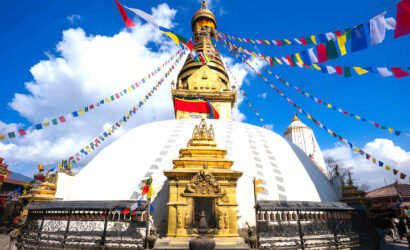
Possible highlights include Kathmandu Durbar Square, where historic palaces, temples, and courtyards reflect the city’s royal past, Swayambhunath (the Monkey Temple) with panoramic views over the valley, Boudhanath Stupa, one of the largest and most important Buddhist stupas in the world, and Pashupatinath Temple, Nepal’s most sacred Hindu temple located along the Bagmati River. Any sightseeing activities on this day are optional and can be arranged as a private guided tour at short notice, subject to availability and at an additional cost.
Whether required as a contingency day or used for cultural exploration, this buffer day adds valuable flexibility to your itinerary while offering an opportunity to experience the vibrant heritage and atmosphere of the Kathmandu Valley.
As your remarkable adventure through the Himalayas comes to a close, take a moment to reflect on the awe-inspiring landscapes, rich cultural heritage, and unforgettable experiences that have defined your journey. From towering mountain scenery to the warm hospitality of local communities, each step has created lasting memories of connection and discovery in Nepal.
Airport Transfer Arrangement
For a smooth and stress-free departure, a representative of our trusted local partner in Nepal will meet you at your hotel approximately 3.5 hours before your scheduled flight. The team will ensure a reliable and comfortable transfer to Tribhuvan International Airport, allowing you to conclude your Nepal experience with ease and peace of mind.
We sincerely thank you for traveling with us and look forward to welcoming you again on future journeys across the Himalayas and beyond.
What’s Included & What’s Not Included
Cost Includes
- All transfers within Nepal are included as per itinerary
- All domestic flights in Nepal as per trekking itinerary
- Trekking accommodation (hotel, lodge and/or tent) as per itinerary
- Small shared room with shared bathroom during the trekking in Nepal
- In Kathmandu and/or Pokhara: stay in a ***hotel with breakfast
- Luggage for porters during the trek (12.5 kg/person)
- 3 meals (breakfast, lunch and dinner) during the trekking
- Unlimited tea or coffee with breakfast during the trekking
- One English speaking guide (trekking/tour) as per itinerary
- Travel insurance for the trekking staff (guide and porters)
- All expenses of the trekking staff during the trekking
- Entrance fees for nature reserves/national parks as per itinerary
- Special trekking/climbing permits as per itinerary
- Sightseeing/wildlife tours if included in the itinerary
- Farewell dinner in Kathmandu before the journey home
Cost Excludes
- Single room/single tent supplement (on request)
- International flight ticket to Nepal (return flight/one way).
- Tourist visa for Nepal (30-50 $, depending on the length of stay)
- Personal insurance (covers: trip/flight cancellation, helicopter rescue)
- Meals (lunch, dinner) in hotels in Kathmandu, Pokhara and other cities
- Tips for trekking staff (recommended: 9€ /10$ per traveller per day)
- Drinks (non-alcoholic, hot or mineral/cooking water) during the lodge trekking
- Personal trekking and/or mountaineering equipment for trekking in Nepal
- Hotel costs in case of early return from trekking for any reason
- Costs incurred due to flight cancellations and additional porters/horses during the trek
- Any additional costs for the service and helicopter shuttle flight KTM - Lukla
- Additional costs incurred due to reasons beyond the control of Jagdamba
- Further proof of pandemics like COVID-19 if required in future.
- Personal expenses during the trek (phone, Wi-Fi, shower, recharge etc.)
- Other costs and things not included in the scope of services
Travel Together – Join Our Fixed Departure Trek
-
Available Group Discount Available Available PackagesDonnerstagAugust 27, 2026SonntagSeptember 13, 2026€2,340€2,10610% Off12Available
-
Available Group Discount Available Available PackagesMittwochSeptember 9, 2026SamstagSeptember 26, 2026€2,340€2,10610% Off12Available
-
Available Group Discount Available Available PackagesFreitagSeptember 18, 2026MontagOktober 5, 2026€2,340€2,10610% Off12Available
-
Available Group Discount Available Available PackagesSonntagSeptember 27, 2026MittwochOktober 14, 2026€2,340€2,10610% Off12Available
-
Available Group Discount Available Available PackagesFreitagOktober 9, 2026MontagOktober 26, 2026€2,340€2,10610% Off12Available
-
Available Group Discount Available Available PackagesSonntagOktober 18, 2026MittwochNovember 4, 2026€2,340€2,10610% Off12Available
-
Available Group Discount Available Available PackagesDienstagOktober 27, 2026FreitagNovember 13, 2026€2,340€2,10610% Off12Available
-
Available Group Discount Available Available PackagesMontagNovember 9, 2026DonnerstagNovember 26, 2026€2,340€2,10610% Off12Available
-
Available Group Discount Available Available PackagesMittwochNovember 18, 2026SamstagDezember 5, 2026€2,340€2,10610% Off12Available
-
Available Group Discount Available Available PackagesFreitagNovember 27, 2026MontagDezember 14, 2026€2,340€2,10610% Off12Available
Essential Trip Information
You will trek through the Everest region via the Everest Base Camp route before heading toward Island Peak Base Camp. The journey includes walking through traditional Sherpa villages, high-altitude valleys, and glacial landscapes. You’ll receive basic mountaineering training, cross glaciers, and use climbing equipment during the ascent. The summit climb of Island Peak (6,189 m) offers outstanding panoramic views of Lhotse, Ama Dablam, Nuptse, and other Himalayan peaks.
Yes, the Island Peak Climbing Expedition is suitable for beginners who are physically fit and have some prior high-altitude trekking experience. No technical climbing experience is required, as essential mountaineering skills—such as using crampons, ice axes, harnesses, and ropes—are taught during the expedition. However, participants should be prepared for long trekking days, high altitude, and cold mountain conditions.
Most trekking days involve 5–7 hours of walking on varied mountain trails. The summit day from High Camp is longer and more demanding, typically taking around 8–10 hours round trip. While the climb is physically challenging due to high altitude and endurance requirements, the technical difficulty is relatively low.
The highest point reached on the Island Peak Climbing Expedition is 6,189 meters (20,305 feet) above sea level. At this elevation, oxygen levels are significantly reduced, placing the body under considerable physiological stress.
As a result, altitude sickness is a serious consideration, even for fit and experienced participants. The expedition itinerary is carefully designed to support safe acclimatization through gradual altitude gains, scheduled acclimatization days, and the established practice of “climb high, sleep low.”
Risks associated with high altitude—including Acute Mountain Sickness (AMS), High-Altitude Pulmonary Edema (HAPE), and High-Altitude Cerebral Edema (HACE)—are managed through slow, staged ascents, experienced guides, and regular health monitoring, including oxygen-saturation checks. Clear protocols are in place for immediate descent if symptoms become severe.
Medication may be used when appropriate but is never a substitute for proper acclimatization. Participant safety always takes priority over summit objectives, and turning back is considered a responsible and successful decision when conditions or health require it.
The best time to climb Island Peak is during the spring (March to May) and autumn (September to November) seasons. These periods provide the most stable weather, clear skies, and excellent visibility, creating ideal conditions for a safe and successful ascent.
In spring, temperatures are relatively moderate at lower elevations, and longer daylight hours support acclimatization and summit attempts. Autumn is equally popular due to dry weather, minimal precipitation, and outstanding panoramic views of the Himalayan peaks.
Climbing Island Peak in winter (December to February) is possible only for highly experienced climbers, as extreme cold, heavy snowfall, and strong winds significantly increase difficulty and risk. The monsoon season (June to August) is not recommended due to frequent rain, poor visibility, slippery trails, and higher risks of landslides and avalanches.
For the best combination of safety, weather conditions, and summit success, spring and autumn remain the preferred seasons for Island Peak expeditions.
Climbing Island Peak requires only basic mountaineering skills, making it accessible for first-time climbers who have good physical fitness and prior high-altitude trekking experience.
Participants should be comfortable walking in crampons, using an ice axe for balance and basic self-arrest, and traveling roped on snow and glacier terrain. These fundamental skills are essential for safe and efficient movement at high altitude.
No advanced technical climbing, steep ice climbing, or rock climbing experience is required. All essential mountaineering techniques are taught and practiced under the supervision of professional climbing guides during acclimatization and pre-summit training days, ensuring participants are confident and well prepared before the summit attempt.
With proper guidance, structured instruction, and preparation, Island Peak is ideal for trekkers taking their first step into high-altitude mountaineering.
Yes, practical climbing training is provided during the expedition to ensure all participants are properly prepared before summit day. Training is usually conducted at Base Camp or High Camp, where conditions closely reflect those encountered during the climb.
Under the supervision of experienced and certified climbing guides, participants receive hands-on instruction in the use of crampons, ice axes, harnesses, and ropes, as well as glacier travel, basic self-arrest techniques, and safety procedures. Team movement and communication on snow and ice are also thoroughly covered.
This structured training ensures participants are confident with their equipment, understand essential safety protocols, and are well prepared for the summit attempt—regardless of prior climbing experience. Safety and preparedness are prioritized throughout the expedition.
All essential group climbing equipment is provided as part of the Island Peak expedition to ensure safety and efficiency on the mountain. This includes ropes, ice axes, crampons, harnesses, helmets, and other required technical safety gear that meet standard mountaineering requirements.
Personal climbing equipment—such as mountaineering boots, down jackets, gloves, and sleeping bags—must be arranged by participants. Most personal gear can be rented or purchased in Kathmandu before the trek.
Additionally, personal climbing gear can also be rented locally in the Everest region (such as in Chhukung), which is convenient for climbers who prefer to travel light. Rental availability and costs may vary by item and season, but this option provides flexibility while ensuring you are properly equipped for the climb.
This arrangement allows participants to choose what best suits their travel plans while remaining fully prepared for a safe and successful Island Peak ascent.
Yes, certified and government-licensed Nepalese trekking guides will accompany you throughout the trekking portion of the expedition, supported by experienced porters to ensure safe travel, proper pacing, and smooth logistical support.
A certified climbing guide joins the group at Chhukung, where the climbing phase of the Island Peak expedition begins. From this point onward, the climbing guide conducts technical training, manages acclimatization, and leads the summit attempt.
This structured guiding approach ensures the right expertise at each stage of the journey—trekking professionals supporting the approach and qualified climbing guides leading the high-altitude ascent—while prioritizing safety and a successful climbing experience for all participants.
Yes, comprehensive travel insurance is mandatory for participation in the Island Peak Climbing Expedition. Your insurance policy must cover high-altitude trekking and climbing up to at least 6,200 meters, which is essential for Island Peak.
The insurance must include emergency medical treatment, high-altitude rescue, and emergency helicopter evacuation in Nepal, as evacuation is often the only rapid response option in remote Himalayan regions. Coverage should be valid for the entire duration of the expedition, including the summit attempt.
Participants are responsible for arranging appropriate insurance before arrival. While we do not recommend a specific provider, we strongly advise choosing a reputable insurer experienced in covering high-altitude mountaineering and Himalayan expeditions. Proof of insurance may be required prior to the climb.
For trekking peaks such as Island Peak, where permits are issued by the Nepal Mountaineering Association (NMA), supplemental oxygen is not routinely provided as part of the expedition, as it is generally not required for standard ascents.
However, if a medical professional specifically recommends carrying supplemental oxygen for additional safety or support at high altitude, it can be arranged in advance upon request. In such cases, all oxygen-related arrangements and costs are the responsibility of the participant.
This policy allows flexibility while maintaining clear medical responsibility and safety standards, enabling participants to make informed decisions based on personal health needs and professional medical advice.
Throughout much of the trekking route, mobile network coverage is available, allowing the guide team to communicate and coordinate assistance when necessary, ensuring timely support while following established safety protocols during the expedition.
Accommodation during the Island Peak expedition includes tea-house lodges during the trekking portion and tented camping at high altitude.
During the trek, you will stay in simple local lodges with twin-share rooms, shared only between two participants. Bathroom facilities are generally shared, and while amenities are basic, they are sufficient for rest and recovery in a remote mountain environment.
Chhukung serves as the expedition base, where accommodation is provided in a lodge. From Chhukung, the climb continues to High Camp, where one night of tented camping is spent at approximately 5,500 meters before the summit attempt.
Single rooms in lodges or private tents may be available upon request at an additional cost, depending on location and availability, but cannot be guaranteed in remote high-altitude areas.
Freshly cooked meals are provided throughout the expedition, prepared at local lodges using available seasonal ingredients. Meals are designed to be nutritious, hygienic, and suitable for high-altitude trekking, helping maintain energy levels and support recovery during long trekking days.
At higher elevations, including High Camp, simple but high-energy meals are served to meet increased calorie demands and support summit-day performance. Food options may be more limited at altitude due to remoteness, but meals are prepared carefully with safety and nutrition as priorities.
Drinking water is treated and made safe throughout the expedition. Water is either boiled or purified using appropriate treatment methods before consumption. Participants are encouraged to carry reusable water bottles or hydration systems to ensure proper hydration and to minimize plastic waste while trekking in the Himalayas.
Basic facilities such as Wi-Fi, electricity charging, and hot (bucket) showers are available at many lodges along the trekking route, including in lower villages and Chhukung. These services are provided by local lodges and are usually available at an additional cost, with prices increasing at higher elevations due to limited resources.
As altitude increases, facilities become more limited and less reliable, depending on location, weather conditions, and lodge infrastructure. At High Camp (around 5,500–5,600 meters), accommodation is in tents, and Wi-Fi, electricity, and hot shower facilities are not available.
Participants are advised to take advantage of available facilities at lower elevations and be prepared for basic conditions during the high-altitude climbing phase of the Island Peak expedition.
Weather conditions in the high Himalayas can change quickly, and summit attempts are entirely weather-dependent. If conditions such as strong winds, heavy snowfall, poor visibility, or extreme cold make climbing unsafe, the summit attempt may be delayed, rescheduled, or cancelled.
The expedition leader and climbing guides closely monitor weather forecasts and on-site conditions. Safety is always the top priority, and decisions are made conservatively based on current and predicted weather, route conditions, and the overall condition of the team. If conditions do not improve within a safe timeframe, the group will descend rather than risk exposure or accidents.
While the itinerary is planned with some flexibility to allow for weather-related delays, summit success can never be guaranteed. Turning back due to unfavorable weather is considered a responsible and professional decision.
Yes, the Island Peak expedition package includes all required permits and core logistical arrangements necessary for the climb. This covers the climbing permit issued by the Nepal Mountaineering Association (NMA), as well as all relevant national park and conservation area permits and official documentation.
The package also includes domestic flights within Nepal as outlined in the itinerary, along with porter support, transportation of group equipment, and full logistical coordination throughout the trek and climbing phase.
This comprehensive arrangement allows participants to focus entirely on the experience, while all essential permits, flights, and expedition logistics are professionally organized and managed in advance.
Summit success is never guaranteed and depends on factors such as weather conditions, individual health, acclimatization, and overall safety. If you are unable to continue or reach the summit due to weather, altitude-related issues, or safety concerns, the decision to turn back will be made by the climbing guide in consultation with the participant. All such decisions are made strictly in the interest of safety, and turning back is considered a responsible and professional outcome, not a failure.
The expedition is operated on a full-service basis, and no refunds are provided if the summit cannot be reached for any reason. The primary objective of the expedition is a safe and well-managed high-altitude experience, with summit success always secondary to participant health and safety.
All bookings are subject to a strict cancellation and refund policy due to advance payments for permits, domestic flights, staff, logistics, and local services. Cancellations made by the participant for any reason—including personal circumstances, illness, or fitness issues—are non-refundable, unless otherwise stated in the booking terms.
If a participant must return early to Kathmandu due to health issues, altitude sickness, weather delays, safety concerns, or personal reasons, no refunds are provided for unused services. Any additional costs related to early return—such as accommodation, meals, flight changes, ground transport, or helicopter evacuation—are the responsibility of the participant.
In rare cases where the expedition is cancelled by the operator due to extreme weather, force majeure, government restrictions, or safety-related circumstances beyond our control, refunds are limited to recoverable costs only, after deducting non-refundable expenses already paid to third parties.
These policies ensure transparency, fair cost management, and safety-first decision-making, which are essential for professionally operated Himalayan expeditions.
Island Peak is an excellent choice if you are seeking your first true Himalayan climbing experience that combines trekking with moderate technical climbing. While it is more challenging than non-technical trekking peaks, it remains achievable for fit trekkers who want to progress into introductory mountaineering with proper training and guidance.
At 6,189 meters, Island Peak offers a rewarding high-altitude climbing experience that includes glacier travel, fixed ropes, and a steeper summit push, providing a strong foundation in alpine climbing skills without requiring advanced technical expertise. The summit rewards climbers with stunning close-up views of Lhotse, Ama Dablam, Nuptse, and surrounding Himalayan giants.
The expedition is professionally guided and well supported, with structured acclimatization, practical climbing training, certified climbing guides, and carefully managed logistics throughout. This makes Island Peak ideal for those looking for a safe, well-organized introduction to technical Himalayan mountaineering while still achieving a challenging and memorable summit.


Write a Review